GPSTrackingvsAVL:WhatistheDifferenceandWhichOneDoesYourFleetNeed?

Axtella Fleet Team
Fleet Management Specialists
Fleet Management
Category
February 11, 2026
Post Date
When businesses in Saudi Arabia begin exploring vehicle tracking solutions, they quickly encounter two terms that seem similar but represent very different levels of capability: GPS tracking and AVL. Understanding the distinction between these approaches is essential for making the right investment decision for your fleet. Choosing too little leaves money on the table through undetected waste and inefficiency. Choosing too much means paying for capabilities you may not need. This guide breaks down the differences clearly to help you make an informed decision.
Understanding the Basics: GPS Tracking
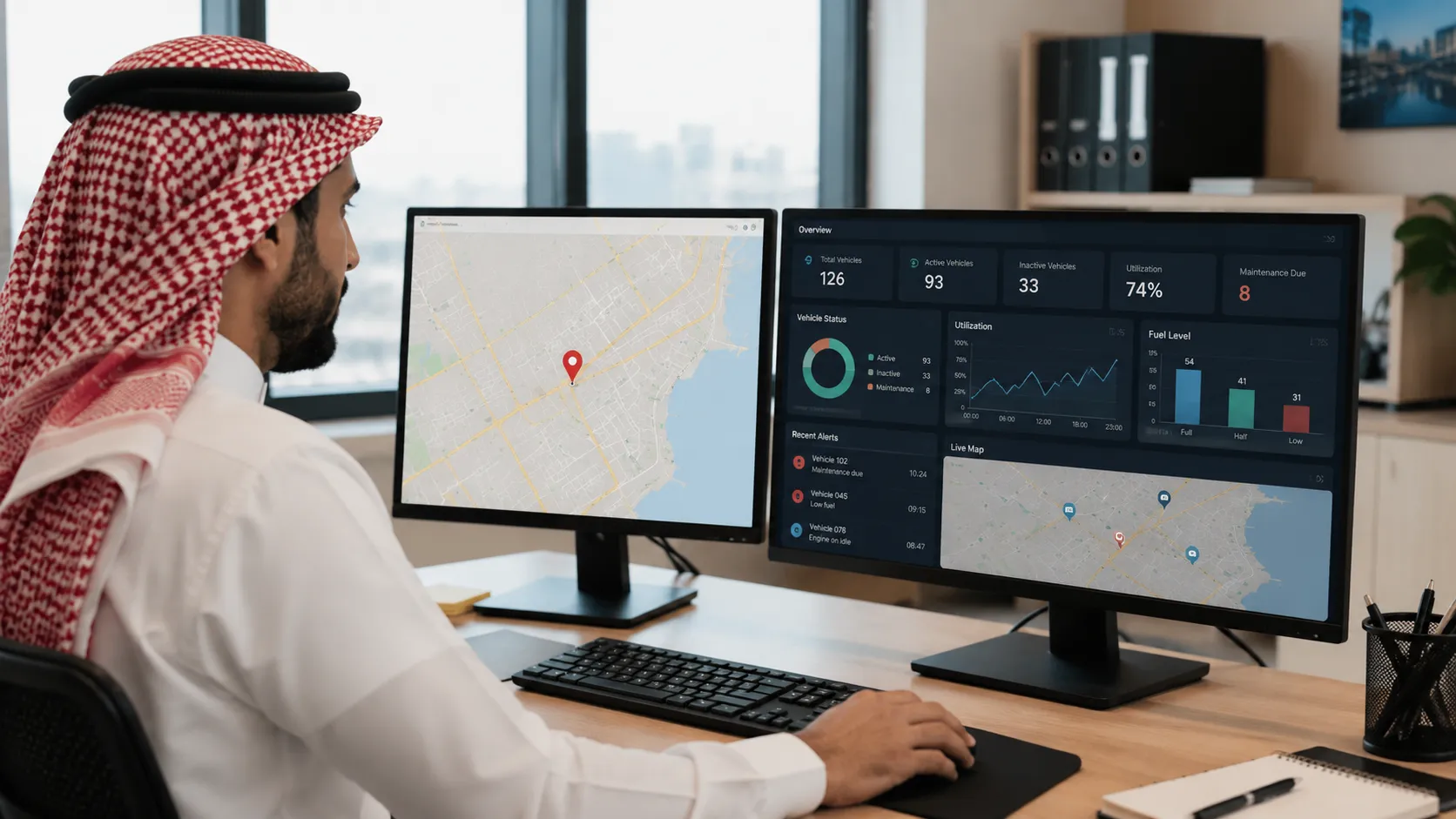
GPS tracking in its simplest form uses Global Positioning System satellites to determine a vehicle's location, then transmits those coordinates to a server via cellular network. Fleet managers see vehicle positions displayed as pins on a digital map. Basic GPS tracking answers one fundamental question: where is my vehicle right now?
The features of basic GPS tracking are typically limited to current location display, basic speed data, simple route history showing where the vehicle has traveled, and rudimentary geofencing with entry and exit alerts. This is what most people picture when they hear the term vehicle tracking — a dot on a map that moves in real-time. For some use cases, this level of visibility is sufficient and represents a meaningful improvement over having no tracking at all.
Understanding AVL: The Complete Fleet Intelligence Platform
Automatic Vehicle Location goes far beyond placing a pin on a map. AVL is a comprehensive fleet management ecosystem where GPS tracking is just one component among many. Modern AVL platforms combine location tracking with real-time driver behavior monitoring and performance scoring, fuel consumption tracking with theft and waste detection, OBD-II engine diagnostics and vehicle health monitoring, predictive maintenance scheduling with automated alerts, video telematics powered by AI dashcams, customizable analytics dashboards and automated reporting, and API integrations with ERP, CRM, and logistics systems.
AVL answers a comprehensive set of business questions: where is my vehicle, how is it being driven, how much fuel is it consuming, when does it need maintenance, is the driver operating safely, and how can I optimize my entire fleet operation? The difference between basic GPS and AVL is analogous to the difference between a simple thermometer and a comprehensive health monitoring system. Both measure something useful, but one provides vastly more actionable intelligence.
When Basic GPS Tracking is Enough
Basic GPS tracking has its place in certain scenarios. For personal vehicle tracking — monitoring a family car for security purposes — a simple GPS tracker provides all the functionality needed at a low cost. Very small fleets of one to five vehicles with straightforward operational needs may find basic tracking sufficient, particularly if the primary concern is simply knowing vehicle locations.
Budget-limited situations where any tracking is better than no tracking may warrant starting with basic GPS as a first step. However, it is important to understand the limitations: basic GPS provides no insight into driver behavior patterns that waste fuel and cause accidents, no predictive maintenance capabilities leaving you reactive to breakdowns, limited reporting that does not support data-driven management decisions, no integration capabilities with business systems, and minimal scalability for growing fleets.
When You Need a Full AVL System
For commercial fleet operations, the business case for AVL over basic GPS is typically overwhelming. AVL becomes essential for commercial fleets of 10 or more vehicles where the cost savings from fuel optimization, maintenance management, and driver safety improvements far exceed the incremental cost over basic GPS. Companies where fuel costs represent a significant expense benefit enormously from fuel monitoring and driver behavior analysis.
Operations requiring regulatory compliance with CST, TGA, and other Saudi authorities need AVL-level capabilities to meet reporting and monitoring requirements. Safety-critical fleets in construction, public transport, and school bus operations need driver monitoring and video telematics to protect lives and manage liability. Any business wanting to make data-driven decisions about fleet operations needs the analytics and reporting capabilities that only AVL platforms provide.
The Hidden Cost of Going Basic
The most important comparison between GPS tracking and AVL is not the subscription price — it is the total cost including the money you lose by not having advanced capabilities. A basic GPS tracker might cost 15 to 25 SAR per vehicle per month, which appears cheaper than an AVL platform at 30 to 56 SAR per vehicle per month.
But without fuel monitoring, the average fleet vehicle wastes 500 to 1,500 SAR per month in fuel through idling, inefficient driving, and undetected theft. Without driver behavior monitoring, accident costs remain high and insurance premiums stay elevated. Without maintenance alerts, unexpected breakdowns cost 5,000 to 15,000 SAR per incident in repairs, towing, and lost productivity. The total cost of not having AVL capabilities can reach 2,000 to 5,000 SAR per vehicle per month in hidden losses.
Compared against AVL subscription costs of 30 to 56 SAR per vehicle per month, the return on investment is typically 5 to 10 times the subscription cost. The cheapest option on the price list is rarely the cheapest option in practice.
Start Basic, Scale to Advanced
The best fleet management providers offer tiered approaches that let you start at the level that fits your current needs and scale up as your fleet and requirements grow. A basic plan provides real-time tracking, location history, basic alerts, and web and mobile access. A standard plan adds driver behavior monitoring, advanced geofencing, trip history, and utilization reports. An advanced plan adds fuel monitoring, driver scoring, maintenance management, custom dashboards, and API access. Enterprise plans include everything plus dedicated support, custom SLAs, and tailored integrations.
This tiered approach means you do not need to commit to the most advanced and expensive option from day one. Start with the level that addresses your most pressing needs, prove the ROI, and then upgrade as you see the value and identify additional optimization opportunities.
Not sure which level is right for your fleet? Get a free assessment from Axtella. We will recommend the perfect plan based on your fleet size, industry, and operational needs. Contact sales@axtellaglobal.com or call +966 55 732 3274.
Related Blogs
School Bus Tracking Solutions in Saudi Arabia: GPS + Parent App for Student Safety
Complete school bus tracking solution for Saudi Arabia with GPS monitoring, real-time parent app, and driver behavior alerts for student safety.
Video Telematics and AI Dashcams: The Future of Fleet Safety in Saudi Arabia
Explore how AI-powered dashcams and video telematics are transforming fleet safety in Saudi Arabia with phone detection, fatigue alerts, and HD evidence recording.
Ready to Grow your Business smarter?
Partner with Axtella for integrated technology and infrastructure solutions tailored to your business needs. From telecommunications and IoT to smart buildings and fleet management — our 250+ professionals deliver end-to-end solutions aligned with Saudi Vision 2030.
Discover MoreEnquiry form
Tell us about your project and our team will get back to you within 24 hours.