FleetManagementforConstructionCompaniesinSaudiArabia:ACompleteGuide

Axtella Fleet Team
Fleet Management Specialists
Fleet Management
Category
February 9, 2026
Post Date
Saudi Arabia is in the midst of the largest construction boom in its history. Mega-projects of unprecedented scale — NEOM at 500 billion dollars, Red Sea Global, Qiddiya, Diriyah Gate, and Jeddah Tower — are transforming the kingdom's landscape and economy. These projects demand massive fleets of heavy equipment, trucks, and support vehicles operating across vast and often remote sites.
For construction companies, managing these fleets presents unique challenges that standard corporate fleet management solutions were not designed to handle. Heavy equipment does not have standard OBD ports. Job sites span enormous areas in remote locations. Fuel theft on unmonitored sites drains budgets. And the extreme Saudi heat — regularly exceeding 50 degrees Celsius — tests both machines and the people who operate them. This guide covers everything construction fleet managers need to know about implementing effective fleet management.
What Construction Fleets Need to Track
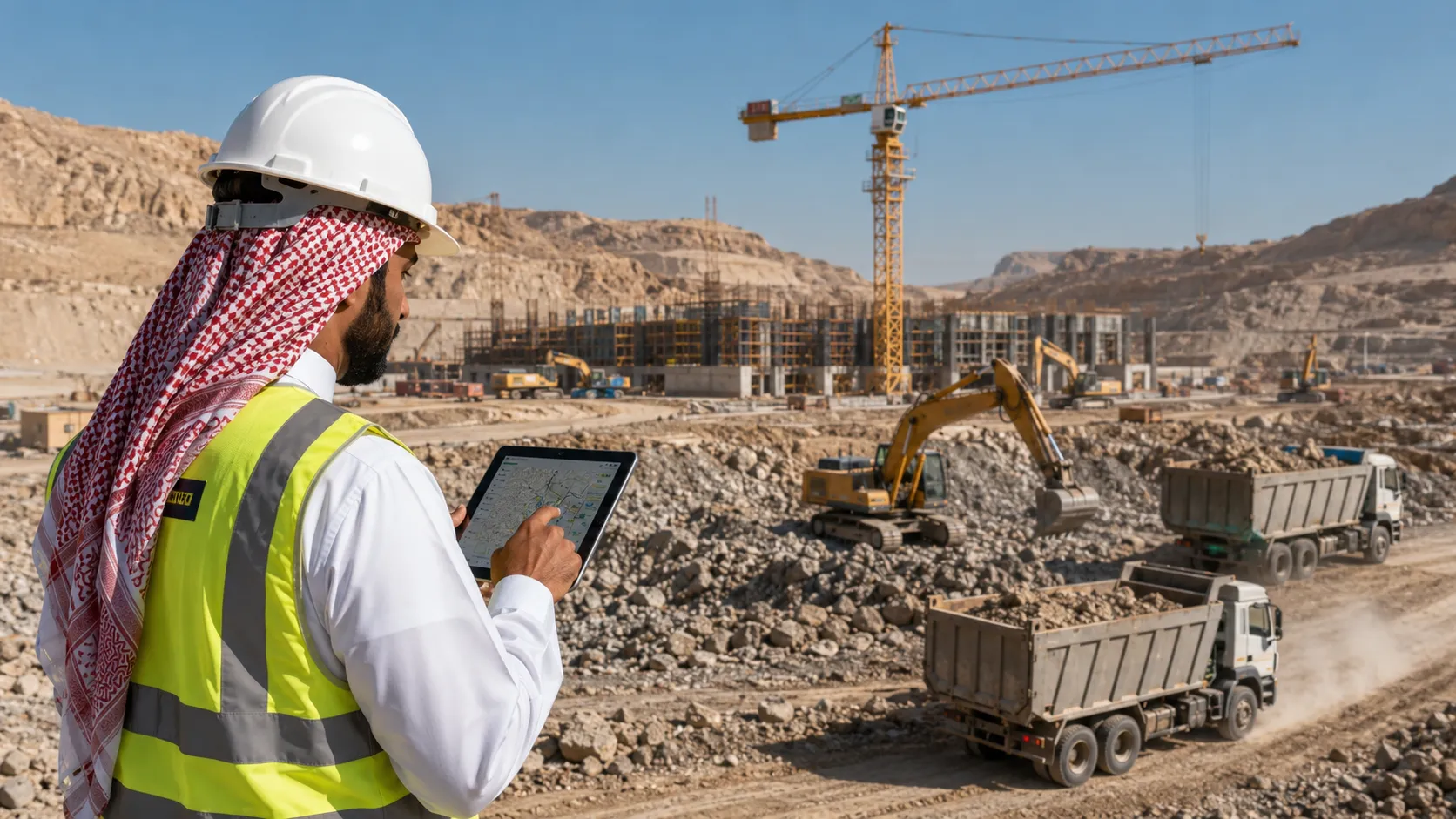
Construction fleets are fundamentally different from standard vehicle fleets. While a logistics company primarily tracks trucks and vans with standard automotive systems, a construction company needs to monitor a diverse mix of assets. Heavy equipment including excavators, bulldozers, cranes, wheel loaders, and graders form the most valuable category. Cement mixers, dump trucks, and flatbed transporters handle materials. Pickup trucks and crew transport vehicles move people between sites.
Beyond vehicles, construction companies also need to track generators, portable equipment, and specialized machinery that may move between sites. Each asset type requires different tracking hardware — hardwired GPS trackers for trucks with standard electrical systems, ruggedized asset trackers for heavy equipment that operates in harsh conditions, and portable trackers for movable machinery and temporary installations. A comprehensive fleet management solution must accommodate this diversity within a single platform.
Geofencing for Construction Site Security
Geofencing is perhaps the most critical fleet management feature for construction operations. By defining virtual boundaries around each job site, construction managers receive instant alerts when any tracked equipment leaves the designated zone. This protects against theft of high-value equipment, unauthorized after-hours use, and accidental misrouting of deliveries.
The system tracks entry and exit times for all vehicles and equipment at each site, creating a detailed log of site activity. Temporary geofences can be created for different project phases as work areas shift and expand. For mega-project sites in locations like NEOM and the Red Sea coast, where sites may cover hundreds of square kilometers in remote areas far from urban centers, geofencing provides a security layer that would be impossible to achieve with physical security alone.
Advanced geofencing features include speed zones within sites where heavy equipment must operate below specific limits, restricted areas where only authorized vehicles may enter, and corridor geofences along haul roads to ensure dump trucks follow approved routes.
Fuel Monitoring on Construction Sites
Fuel theft is a massive and persistent problem on construction sites, particularly in remote areas where oversight is limited. Diesel for heavy equipment represents one of the largest line items in any construction budget, and industry studies suggest that 8 to 15 percent of fuel expenditure on construction sites is lost to theft, fraud, or waste.
Fuel level sensors connected to GPS tracking devices monitor tank levels in real-time for each piece of equipment. The system detects sudden drops in fuel level that are inconsistent with normal consumption — a clear indicator of siphoning. Fill-up verification compares fuel card transaction records with actual tank level increases, catching discrepancies that indicate fraud or diversion.
Generator fuel monitoring is particularly important on construction sites, where large generators often consume significant quantities of diesel in remote areas with no grid power. By tracking generator fuel consumption against power output, managers can identify units that are running inefficiently or being fueled beyond their needs. Real-time alerts for unexpected fuel level drops ensure that theft is detected immediately rather than discovered during monthly reconciliation.
Equipment Utilization and Maintenance
Construction companies invest millions of riyals in heavy equipment, and maximizing the return on that investment requires accurate utilization data. Fleet management systems track engine hours for each piece of equipment, revealing exactly how much each asset is actually being used versus sitting idle.
This data is invaluable for multiple decisions. Underutilized assets can be redeployed from one site to another where they are needed, rather than renting additional equipment unnecessarily. Rental versus purchase decisions are informed by actual utilization rates across the fleet. Project cost allocation becomes accurate when equipment hours are tracked per site.
Maintenance scheduling based on engine hours rather than calendar dates ensures that heavy equipment receives service when it actually needs it. A crane that runs 12 hours a day needs more frequent maintenance than one used intermittently, and engine-hour-based scheduling accounts for this automatically. Real-time diagnostic monitoring catches developing problems before they cause costly breakdowns that delay project timelines and require expensive field repairs.
Driver and Operator Safety
Safety on construction sites is paramount, both for regulatory compliance and for protecting workers. Fleet management systems contribute to safety by monitoring vehicle speeds both on and off site, ensuring dump trucks and cement mixers comply with speed limits in construction zones. Seatbelt usage and cabin door status monitoring add additional safety data points.
AI dashcams detect operator fatigue during long shifts — a critical concern when operators are controlling heavy equipment that can cause serious harm if operated while drowsy. Safety zone alerts trigger when vehicles approach restricted areas, pedestrian zones, or active work areas on site. When incidents do occur, video evidence from dashcams provides objective documentation for investigation, learning, and training.
Compliance with Saudi labor safety regulations requires documentation of safety practices, and fleet management systems automatically generate the records needed to demonstrate compliance during audits and inspections.
Multi-Site and Sub-Contractor Management
Construction companies typically operate across multiple project sites simultaneously, often with numerous sub-contractors contributing vehicles and equipment to each project. Fleet management platforms designed for construction provide dashboard views showing all sites on a single map, with the ability to drill down into any individual project.
Vehicles and equipment can be assigned to specific projects for accurate cost allocation, ensuring that fuel, maintenance, and utilization costs are attributed to the correct project budget. Sub-contractor vehicles can be given temporary access to tracking dashboards with limited permissions, allowing coordination without exposing proprietary fleet data.
Role-based access ensures that project managers see only their sites, while operations directors have a fleet-wide view. API integration with project management and ERP software enables automated workflows — when a piece of equipment is reassigned between sites, the change is reflected in both the fleet management and project management systems simultaneously.
Getting Started with Construction Fleet Management
Implementing fleet management for a construction fleet requires a provider who understands the unique needs of the industry. Standard fleet tracking solutions designed for road vehicles often lack the ruggedized hardware, flexible tracking options, and construction-specific features that make the difference between a useful tool and a frustrating one.
The right solution includes CST-approved hardware that can withstand Saudi Arabia's extreme conditions, fuel sensors designed for heavy equipment tanks, asset trackers that operate on battery power for equipment without electrical systems, and a platform that handles the diversity of construction fleet assets.
For mega-project contractors working with NEOM, Red Sea Global, and other government-linked developments, enterprise solutions with dedicated account management, custom integrations, and SLA-based support ensure that fleet management meets the demanding requirements of these high-profile projects.
Managing a construction fleet? Get a customized fleet solution for your project. Contact Axtella at sales@axtellaglobal.com or call +966 55 732 3274.
Related Blogs
School Bus Tracking Solutions in Saudi Arabia: GPS + Parent App for Student Safety
Complete school bus tracking solution for Saudi Arabia with GPS monitoring, real-time parent app, and driver behavior alerts for student safety.
Video Telematics and AI Dashcams: The Future of Fleet Safety in Saudi Arabia
Explore how AI-powered dashcams and video telematics are transforming fleet safety in Saudi Arabia with phone detection, fatigue alerts, and HD evidence recording.
Ready to Grow your Business smarter?
Partner with Axtella for integrated technology and infrastructure solutions tailored to your business needs. From telecommunications and IoT to smart buildings and fleet management — our 250+ professionals deliver end-to-end solutions aligned with Saudi Vision 2030.
Discover MoreEnquiry form
Tell us about your project and our team will get back to you within 24 hours.